The Champions League and Continental Cup pay real Gold prizes. Thousands of Gold per season, split across group stage wins, knockout rounds, and finals. But that Gold doesn't appear from nowhere. It comes from the Global Fund, and the Global Fund gets it from the clubs.
Transfer fees, stadium upgrades, youth signings, player tweaks, staff hires. A cut of each one ends up in the Global Fund. That fund accumulates Platinum and Gold throughout the season, converts the Platinum into Gold, and when the new season starts, carves out the prize pools for the Champions League and Continental Cup.
Here's how the whole thing works.
Four zones, four funds
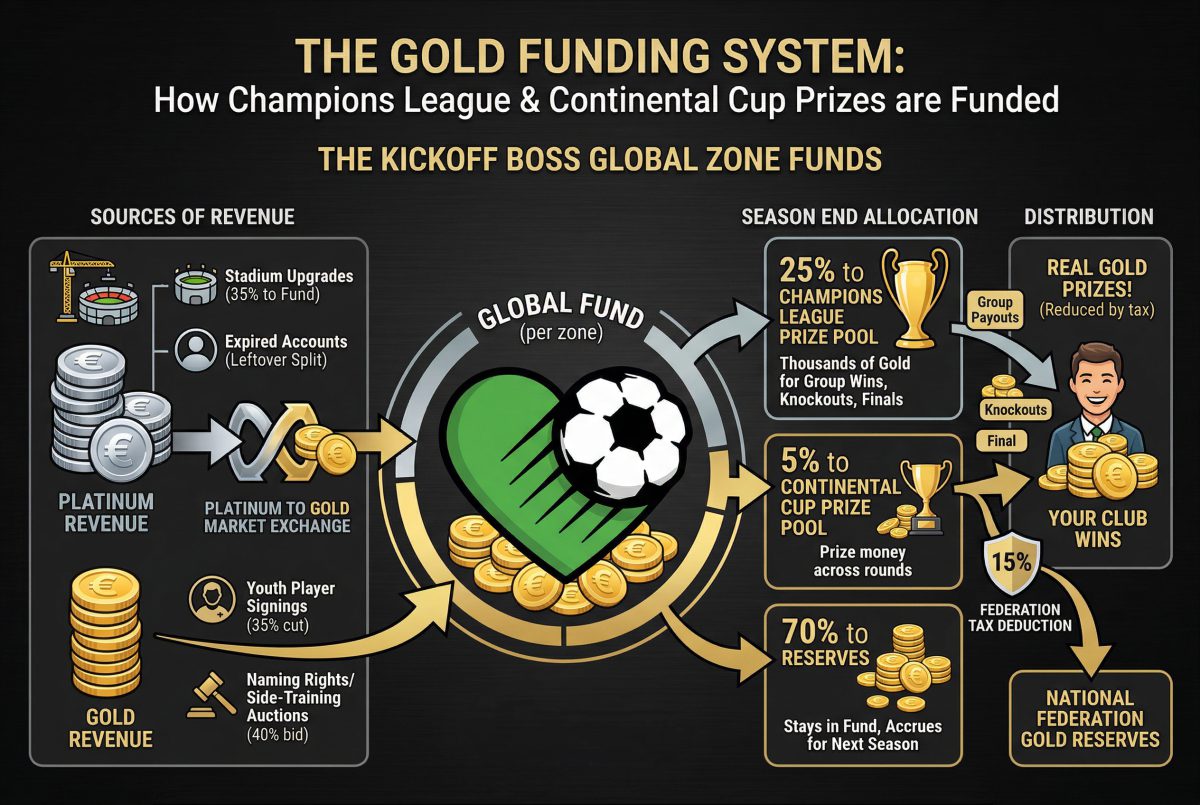
There isn't one Global Fund. There are four, one per continental zone: Europe, Asia & Oceania, Americas, and Africa. Each one operates independently. European clubs feed the European fund, European competitions pay out from it. A busy transfer market in England doesn't affect prize money in Nigeria.
Right now, Europe's fund holds around 109,000 Gold in reserves. The Americas sits at about 8,900. Asia & Oceania and Africa hold around 3,800 and 3,600. The differences come down to how much economic activity happens in each zone.
Where the Platinum comes from
A few different revenue streams feed Platinum (the euro-denominated currency) into the Global Fund.
Stadium upgrades. Expand your stadium and 35% of the cost goes to the Global Fund as Platinum, 30% to the Partners Fund, 35% to your federation.
Expired user accounts also feed into this. When a manager's account expires and they have no recruiter to inherit their Platinum balance, the leftover Platinum is split equally across all four zone funds.
Where the Gold comes from
Other sources feed Gold directly.
Youth player signings take a 35% cut for the Global Fund. The signing fee splits three ways: 35% Global Fund, 30% Partners Fund, 35% your federation.
Naming rights auctions and side-training auctions both send 40% of the winning bid to the Global Fund in Gold. The other rest goes to the Partners Fund (20%) and the player's federation (40%).
Staff siging like coaches and scouts also pay a fee to the Global Fund.
There's a smaller stream too. When a referred player generates income but their recruiter no longer has a team, the 10% recruiter tax goes to the Global Fund instead of disappearing.
Platinum becomes Gold
Platinum sitting in the fund doesn't stay as Platinum for long. The system checks each zone's fund. Any Platinum balance of 1 or more gets sold on the exchange market for Gold.
It's not a flat conversion. Each unit of Platinum is sold one at a time through the same exchange rate mechanism that you'd use yourself. There's a spread on each sale, and that spread goes to the Partners Fund as a fee. The rate moves with each transaction, same as when you sell Platinum manually. If the fund has 50 Platinum to convert, it sells them one by one, each at a slightly different rate.
After each run, the fund's Platinum balance drops to near zero and its Gold balance grows. Over a full season, this is how all those fees and stadium costs become spendable Gold.
Season start: carving the prize pools
On the last day of each season, during the transition, the system allocates Gold from each zone's Global Fund into two competition prize pools.
25% of the fund's total Gold goes to the Champions League. 5% goes to the Continental Cup. The remaining 70% stays in the fund and keeps accumulating.
For Europe this season (22), that worked out to about 36,400 Gold for the Champions League and 7,280 for the Continental Cup. For the Americas, roughly 2,900 and 580. Smaller zones get smaller pools because less money flows through their economies.
Any Gold left unspent from the previous season's competitions (unmanaged teams dont get paid) gets returned to the fund first, then the new 25/5 split happens on the updated total. Nothing gets thrown away.
How the Champions League prize money is divided
Once the 25% is carved out, it gets subdivided into specific prizes per stage. The exact split depends on whether a zone runs 8 groups or 4.
In Europe (8 groups), the current season's Champions League fund breaks down like this:
10% goes to group stage match wins, shared across all group victories. Each win pays Gold.
28% is split among the 16 teams that qualify from the group stage.
20% goes to the Round of 16 winners (8 teams, about 910 Gold each), and another 20% to the quarter-final winners (4 teams).
12% is split between the 2 semi-final winners. The final winner takes 8% of the fund. The runner-up gets 2%.
Add it all up and a team that wins the European Champions League from the group stage through to the final collects a lot of Gold across all rounds.
The Continental Cup follows the same structure
The Continental Cup gets 5% of the fund instead of 25%, so the numbers are smaller. But the distribution percentages are the same. In Europe this season, qualifying from the group pays about 127 Gold, a quarter-final win is worth 364, and the final winner takes home about 583.
Smaller prizes, but they matter for clubs outside the Champions League. And for smaller zones, these payouts can be the gap between a profitable season and breaking even.
The 15% government cut
Every prize payment in both competitions has 15% deducted before it reaches your club. That 15% goes to your national federation's Gold reserves.
Win a Champions League quarter-final worth 1,820 Gold and your club actually receives about 1,547. The other 273 goes to your country's federation, where it eventually funds league prizes, cup prizes, and the Victory Fund.
The tax applies to every payout. Group wins, knockout advances, the final, the runner-up consolation. No exceptions.
Where it all connects
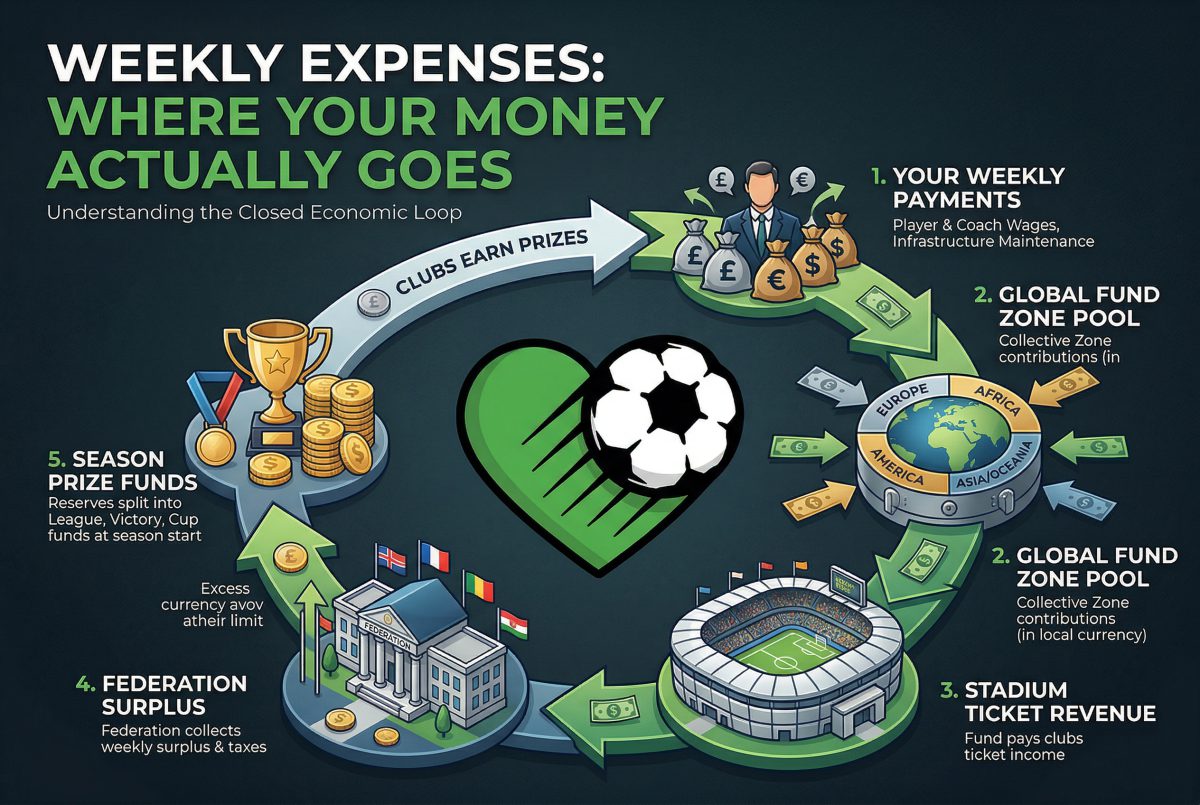
The last blog post covered how your weekly wage payments flow into the Global Fund and become stadium ticket revenue and federation funding. This is the other half.
A youth signing you complete in week 3 of one season might end up funding a Champions League semi-final prize two seasons later.
Checking the numbers yourself
If you're competing in the Champions League, check the Global Fund page before the season starts. The fund's current Gold balance tells you what next season's prize pool will look like. Multiply by 0.25 for the CL pool, 0.05 for the CC.
Europe's Champions League fund is roughly 30 times larger than Africa's right now. That's a direct result of how many managers are active and how much they spend. Not a fixed rule, just how the math works out.
The 70% that stays in the fund doesn't sit idle. If the fund grows faster than it pays out in a given season, next season's allocations will be bigger.