Deutsch
 English
 Español
 Français
 Hrvatski
 Indonesia
 Italiano
 Nederlands
 Norsk
Norsk Português
 Português, Brasil
 Română
 Svenska
 Türkçe
 Ελληνικά
 Български
 Српски
 العربية
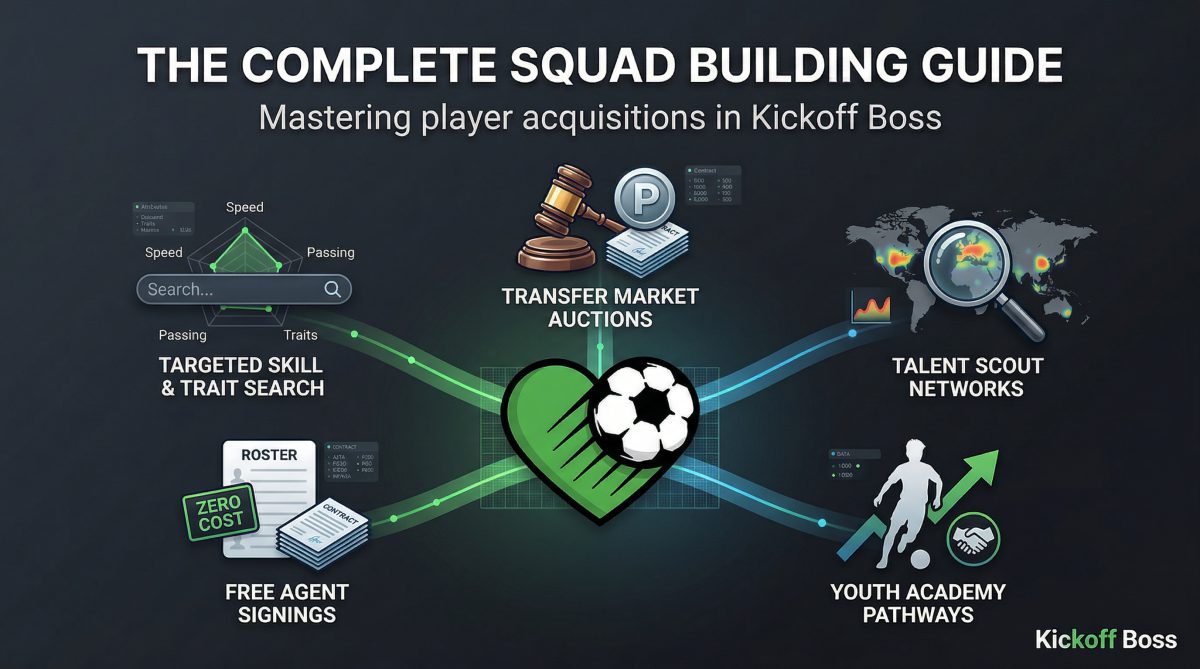
Kickoff Boss gives you five ways to build your squad, each using different currencies and carrying different risks. Here's how they work.
The transfer market
Any manager can list up to three players for sale at a time, with auction windows of 24, 48, or 72 hours. Starting bids are set at 10% of estimated value, and everything is priced in Platinum, the premium currency pegged 1:1 to the Euro.
If a bid comes in during the last five minutes, the clock extends. No sniping. When a deal closes, the selling club gets 98% of the fee. The other 2% goes to the player's original training club as a solidarity payment, so developing a youngster still pays off even if you sold them two seasons ago.
Search filters cover position, preferred foot, playing side, age, average quality, potential, nationality, special traits, and all twelve skill attributes. If you know what you need, you can find it.
Pro tip: Buy young, develop, sell at peak. One well-timed transfer can cover a season's running costs.
The free player market
When clubs release players, they go into the Free Player Market, split by zone: Europe, Americas, Africa, Asia.
What you can see depends on your scouting network. A scout in a zone means full visibility of everyone available there. Without one, you get a limited list. Checking a player's hidden potential before bidding costs 0.05 Gold.
Auctions use Gold, and each new bid has to beat the previous by at least 5%. It moves slower than the transfer market. Patience helps, and so does looking at players before the competition does.
The youth academy
Youth prospects arrive at age 15, with attributes revealed gradually over 10 days:
- Day 1: Height and preferred foot
- Day 3: Whether they have a special trait
- Day 5: Average quality rating
- Day 7: Full skill breakdown
- Day 9: Exact playing position
You decide when to commit. Sign early with limited information and you might get a bargain before anyone else spots them. Wait for the full picture and you risk losing them to a manager who moved first.
When you sign, you pick a star rating (1-5) that sets development speed. A 5-star signing develops five times faster than a 1-star but costs significantly more Gold. Your Youth Center level (upgradeable 1-5) controls which tiers you can access and how many prospects you can take on each season: 3 at level 1, up to 11 at level 5.
Your own country's prospects are always visible for free. Other countries need a scout assigned to that zone. Once a youth player turns 17, they can be promoted to the first team, as long as you have dressing room space.
Pro tip: 1-star and 2-star signings are worth taking seriously. Cheap, develop reliably, and keep the squad ticking while the expensive prospects are still a few seasons away.
Amateur signings
Each country has a pool of amateurs you can sign, up to three per season at a flat 10 local currency each. No auction, no bidding. Pick someone, they're yours.
They won't win you anything, but when injuries pile up or you're short in a position, amateurs cover the gap without touching your Gold or Platinum budget.
Scouting
Scouts don't sign players, but they change what you can see across every other market. They cost around 141 Gold each through the Staff page, one per zone maximum.
A scout in a zone gives you full visibility of free players there (not just the public list), access to foreign youth prospects from any country in the zone, and the ability to scout individual players for 0.05 Gold to reveal their hidden potential.
Without coverage in a zone you're guessing at value. Other managers with scouts there aren't. Over a season, that difference shows up in the signings you make and the ones you miss.
Putting it together
Most managers end up using all five. Transfer market for proven quality when you need it now. Youth academy for the long game. Free market for value if you've done your scouting. Amateurs when something breaks and you need a quick fix.
The budget is always tight, the scout network takes seasons to build, and Youth Center upgrades are expensive. That's kind of the point. If squad building were easy, the decisions wouldn't mean anything.