Deutsch
 English
 Español
 Français
 Hrvatski
 Indonesia
 Italiano
 Nederlands
 Norsk
Norsk Português
 Português, Brasil
 Română
 Svenska
 Türkçe
 Ελληνικά
 Български
 Српски
 العربية
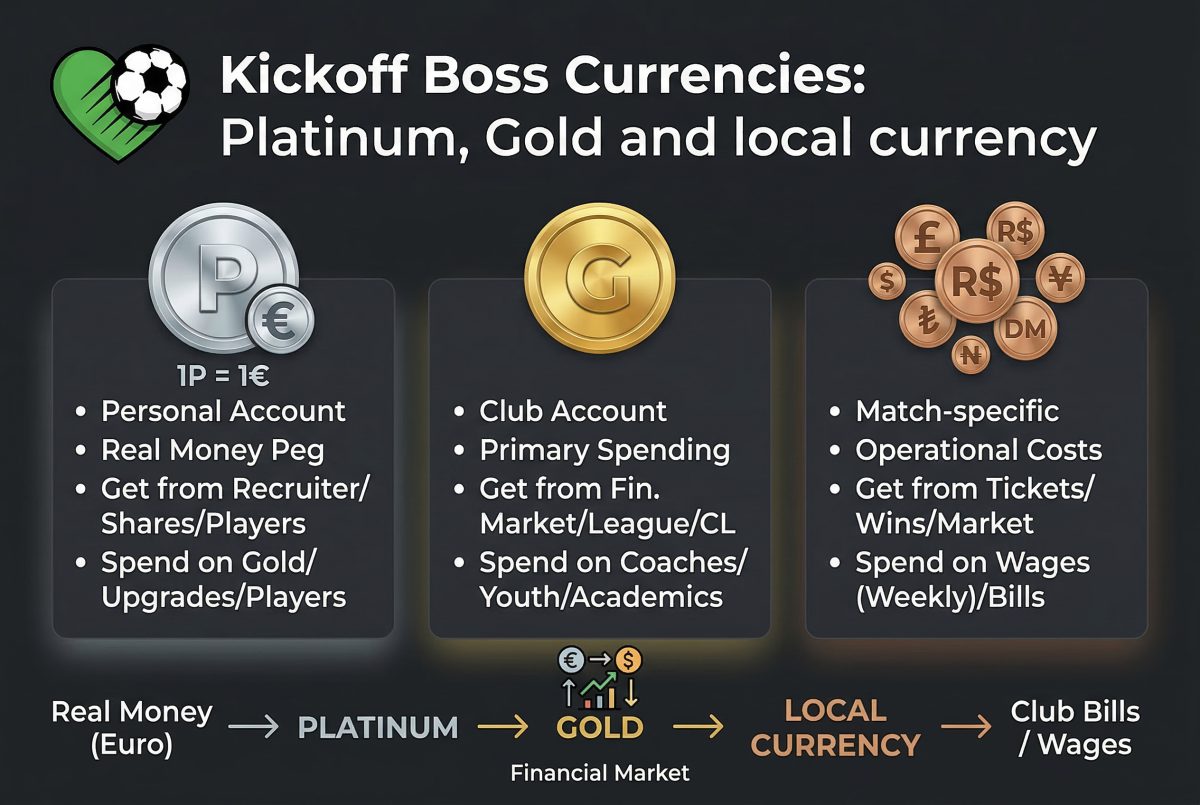
Kickoff Boss has three currencies. Each one does something different, and they connect through the Financial Market. Here's what they are and how they work.
Platinum
Platinum is pegged to real money: 1 Platinum = 1 Euro. You can move it back and forth from your clubs to your personal account.
You get Platinum by buying it directly with real money, from recruiter commissions (10% of whatever your recruits earn), from Partners Fund dividends if you hold shares, and from selling players on the transfer market.
You spend it on converting to Gold through the Financial Market, stadium and facility upgrades, buying players on the transfer market, and referral rights auctions.
Most Platinum ends up getting converted to Gold. That's the main pipeline into your club's economy.
Gold
Gold belongs to your club, not your user account. It covers most spending outside of weekly bills.
The most direct way to get Gold is selling Platinum on the Financial Market. Beyond that, your federation pays Gold for league position at the end of each season (higher divisions get more), cup rounds pay Gold for advancing, and the Champions League and Continental Cup hand out the biggest Gold payouts in the game. You can also sell your local currency for Gold on the Financial Market.
On the spending side: coaches and scouts cost Gold to hire, spawning youth players from your academy costs Gold, player naming auctions and side training auctions are paid in Gold too. You'll also spend Gold when you need to buy local currency.
If you're building your club beyond the pitch, coaches, scouts, youth players, you're spending Gold.
Local currency
Every country has its own. England uses GBP, Brazil uses BRL, Germany uses DEM. Your club holds a balance in whatever currency matches the country it plays in.
You earn local currency from home match ticket revenue (paid out of the Global Fund, which collects wage payments from every club in your continental zone), from the Victory Fund when you win matches during the season, and by converting Gold on the Financial Market. New managers also get a one-time 100 local currency bonus for verifying their phone number during the starting tutorial.
Every Monday, your club pays player wages, coach wages, scout wages, and infrastructure maintenance, all in local currency. Wages are calculated in Platinum first and then converted through the exchange rates, so every club pays the same relative amount regardless of country. If you have more local currency than you need, you can sell it back for Gold.
This is the currency that keeps your club running. If your balance goes negative, your players perform worse on the pitch. Stay negative for three consecutive weeks and the board sacks you. Always keep a buffer.
The Financial Market
Two exchange pairs connect the three currencies.
Platinum and Gold
There's one global rate between Platinum and Gold, currently sitting around 28 Gold per 1 Platinum.
Sell Platinum for Gold and the rate ticks up slightly. Buy Platinum back with Gold and it ticks down. Each transaction moves the rate by a small amount, and a spread on each trade goes to the Partners Fund as a fee. The rate responds to what managers are doing. When lots of people sell Platinum, the rate climbs. When people buy it back, the rate drops.
Gold and local currency
Each country has its own exchange rate between Gold and local currency. England's rate moves independently from Brazil's or Italy's.
Buy local currency with Gold and the rate drops. Sell local currency for Gold and it rises. Same idea as the Platinum-Gold pair, but isolated to each country. A tax on every trade gets to the national federation of that currency, so exchange activity in your country directly feeds next season's prize pool.
You can't move unlimited amounts. The cap is roughly 3x your weekly wage bill converted to local currency, with a floor of 10,000 units. There's also a short cooldown between trades on the same pair to keep anyone from hammering the rate.
How rates move
The step size per trade isn't constant. It scales with the current rate. At low rates (under 5), each trade shifts the rate by 0.0001. At higher rates (50-60 range), the step jumps to 0.005. That means high-rate currencies swing more per trade, while low-rate ones barely move.
Countries with lots of active managers see more volatility. Quiet countries stay flat for weeks.
How money flows through the game
Real money enters the game as Platinum. Managers convert Platinum to Gold on the Financial Market. Gold gets spent on building the club, staff, youth, auctions, or converted into local currency. Local currency pays weekly wages. Those wage payments enter the Global Fund. The Global Fund pays stadium ticket revenue back to clubs in local currency. Whatever surplus the Global Fund has above 5,000 per currency goes to the national federation. Federations stockpile all season and distribute prizes at season end in Gold and local currency.
So the Platinum you convert on Monday can end up funding someone's league prize a few months later. Your wage bill this week becomes gate receipts at another club's stadium by Tuesday.
Practical tips
Keep 2-3 weeks of wages in local currency at all times. Going negative hurts your squad immediately, and three weeks of debt gets you fired.
Check the Platinum-Gold rate before you sell. If lots of managers have been converting recently, the rate will be high, meaning more Gold per Platinum. If you're not in a rush, waiting for a better rate pays off.
Local exchange rates cut both ways. A strong local currency means your weekly wages cost less in Gold terms. But it also means the federation gives you less local currency when it pays out the Victory Fund. You save on one end, lose on the other.
Pay attention to the exchange market, don't just use it when you're broke. Managers who watch rate movements can buy local currency when it's cheap and hold it, or sell when the rate is favorable.
Every fee you pay on the market goes somewhere useful. Exchange taxes feed the Partners Fund and the federations. Wages feed the Global Fund. The more economic activity happening in your country and zone, the bigger the prize pools get for everyone playing there.