Deutsch
 English
 Español
 Français
 Hrvatski
 Indonesia
 Italiano
 Norsk
Norsk Polski
 Português
 Português, Brasil
 Română
 Svenska
 Türkçe
 Ελληνικά
 Български
 Српски
 العربية
Training is where long-term success is built. You can buy quality players, but developing the ones you have is cheaper, more reliable, and often the difference between mid-table and promotion. The system isn't complicated, but there are real decisions that affect how fast your players grow. Here's the full picture.
The basics
You can run one training session per day, even during off season. Each session pushes every player in your squad toward their next skill level-up. Players accumulate progress points, when they hit 100, they can gain a skill point, you do it manually or automatically in whichever attribute you've selected for auto-training. Progress then resets and the cycle starts again.
One thing to know early: changing a player's training type resets their current progress to zero. So don't switch types casually. Pick a direction and commit.
What determines progress
Every training session, each player's progress gain is calculated from six multipliers working together:
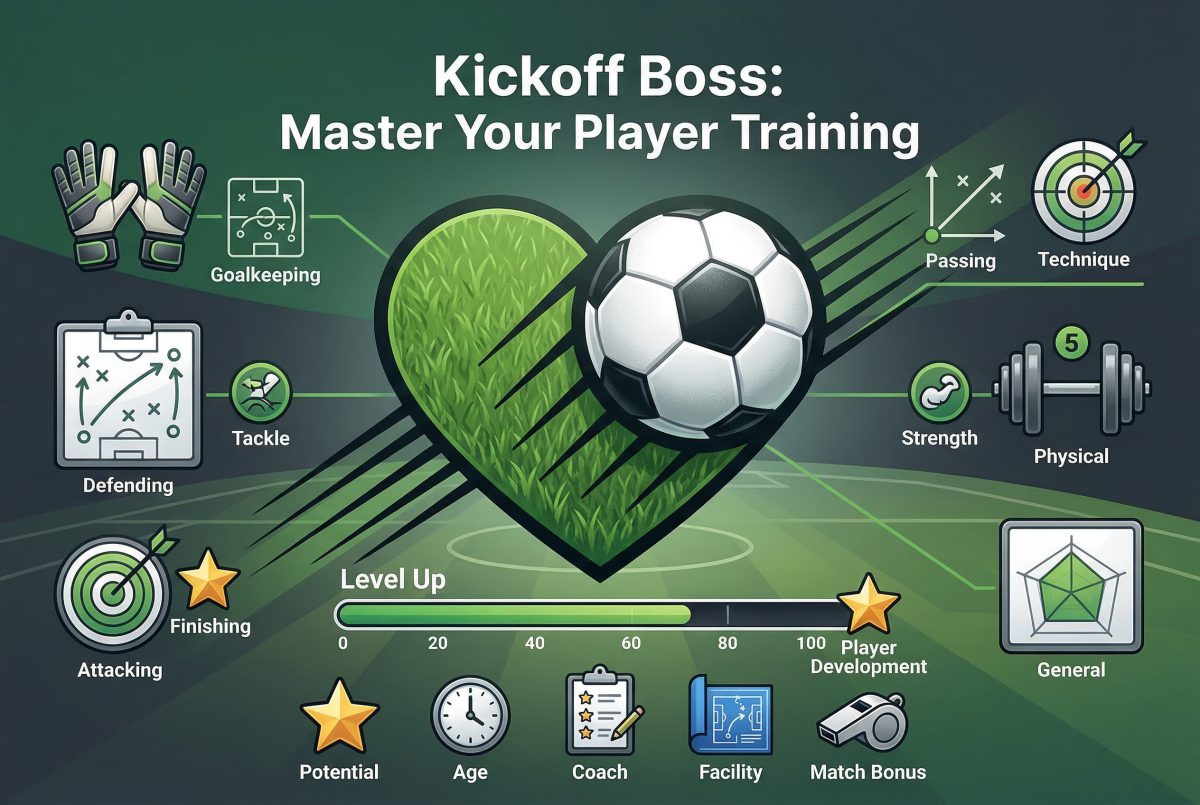
Progress = Potential × Age × Coach × Facility × Match Bonus × Tutor
All six multiply against each other. A strong setup across every factor compounds; a weakness in any one of them drags the whole thing down. Let's break them apart.
Age: the biggest factor
Young players train dramatically faster than older ones. This isn't a small difference, it's the single largest multiplier in the formula.
- Under 16: 3.0×
- 16–19: 2.5×
- 20–22: 2.0×
- 23–25: 1.5×
- 26–29: 1.2×
- 30–33: 1.0×
- 34+: 0.8×
A 17-year-old trains 2.5 times faster than a 30-year-old in identical conditions. This is why youth development matters. A talented teenager with a few seasons of focused training can overtake a more experienced player who's past his development window.
Players over 34 actually train slower than baseline. At that point you're managing decline, not building toward something.
Coaches: the upgrade that pays for itself
Coaches are where most managers first feel the difference. Without a specialized coach, players train on the "General" type at a 1.5× multiplier, decent, but limited. With a specialized coach, the multiplier jumps significantly:
- 1-star coach: 2.2×
- 2-star coach: 2.4×
- 3-star coach: 2.6×
- 4-star coach: 2.8×
- 5-star coach: 3.0×
Even a basic 1-star specialized coach gives you 47% more progress than General training. A 5-star coach doubles it. That's not marginal, over a season of training sessions, it's the difference between 10 skill-ups and 20.
The trade-off with specialized coaching: it limits which skills your player can level up. A player on Attacking training can only improve finishing, positioning, off the ball, heading, and set pieces, nothing else. General training lets you improve any skill, but at a slower rate. So you're choosing between speed and flexibility.
The six training types
Each type restricts which skills a player can level up:
- General — any skill, but slower. No coach required.
- Goalkeeping — handling.
- Defending — tackling, positioning, off the ball, heading, set pieces.
- Attacking — finishing, positioning, off the ball, heading, set pieces.
- Technique — passing, technique.
- Physical — strength, speed, natural fitness.
Training facilities
Your training ground level (1 through 5) provides a steady multiplier to every session:
- Level 1: 1.2×
- Level 2: 1.4×
- Level 3: 1.6×
- Level 4: 1.8×
- Level 5: 2.0×
A level 5 training ground gives your whole squad 67% more progress than level 1. It's a quiet, compounding advantage, every player, every session, every season. If you're planning to develop youth players seriously, upgrading your training ground should be a priority.
Match bonus
Players who played a match in the 24 hours (at least 15 minutes) before training get a 1.5× bonus. That's a 50% boost just for getting game time. This matters for squad rotation decisions: giving a young player minutes isn't just about match experience, it directly accelerates their training that round.
Potential ability
A player's star rating (1–5) acts as a base multiplier. A 5-star potential player gains five times as much progress per session as a 1-star. You can't change potential, it's what you scouted for. But it's why a high-potential youth player with average skills today can be your best player in a few seasons.
Tutoring youth players
Youth players can receive a tutoring bonus (1.5×) from senior players over 29 in the same position group. It's a meaningful boost that stacks with everything else. If you've got an aging defender and a promising youth center-back, the veteran is still contributing to your squad even if he's not starting matches.
A real example
Take an 18-year-old striker with 5-star potential, a 3-star attacking coach, level 3 training facilities, and a match played yesterday:
Progress = 5 × 2.5 × 2.6 × 1.6 × 1.5 = 78 points per session
At 78 points per session, he's leveling up a skill almost every round. That's fast. In a 28-day season, he could gain 20+ skill points across multiple attributes.
Now compare: a 31-year-old with 3-star potential, General training, level 2 facilities, no match:
Progress = 3 × 1.0 × 1.5 × 1.4 × 1.0 = 6.3 points per session
That's roughly 16 rounds per skill-up. Same training session, wildly different outcome. The system rewards investing in young talent with the right infrastructure.
Skill caps and diminishing returns
Skills max out at 100. But even before the cap, improvement slows down as skills get higher:
- Skill 0–59: full +1.0 per level-up
- Skill 60–69: +0.8 per level-up
- Skill 70–79: +0.6 per level-up
- Skill 80–99: +0.4 per level-up
This means pushing a player from quality 75 to 80 takes noticeably longer than pushing from 50 to 55. Plan accordingly, sometimes it's better to round out a player's weaker skills than to chase those last few points on an already-strong attribute.
Rest: when not to train
Players with low condition perform poorly in matches. You can toggle individual players to rest status before running a session, resting players skip training but gain +2 condition immediately.
This is a trade-off: condition now versus development later. For key players heading into important matches, resting is often the right call. For youth prospects who aren't in the first team, keep them training.
Practical takeaways
Upgrade your training ground early. It affects every player, every session, the return compounds over time.
Hire specialized coaches as soon as you can afford them. Even a cheap one is significantly better than General training.
Give young players match minutes when possible. The 50% training bonus from recent matches is too large to leave on the table.
Don't switch training types unless you have a good reason. Resetting progress to zero wastes sessions you can't get back.
Focus your best training infrastructure on high-potential youth. A 5-star 17-year-old with good coaches and facilities develops at a completely different rate than the same player left on General training with no upgrades. The gap shows up within a few rounds.