Deutsch
 English
 Español
 Français
 Indonesia
 Italiano
 Nederlands
 Norsk
Norsk Polski
 Português
 Português, Brasil
 Română
 Svenska
 Türkçe
 Ελληνικά
 Български
 Српски
 العربية
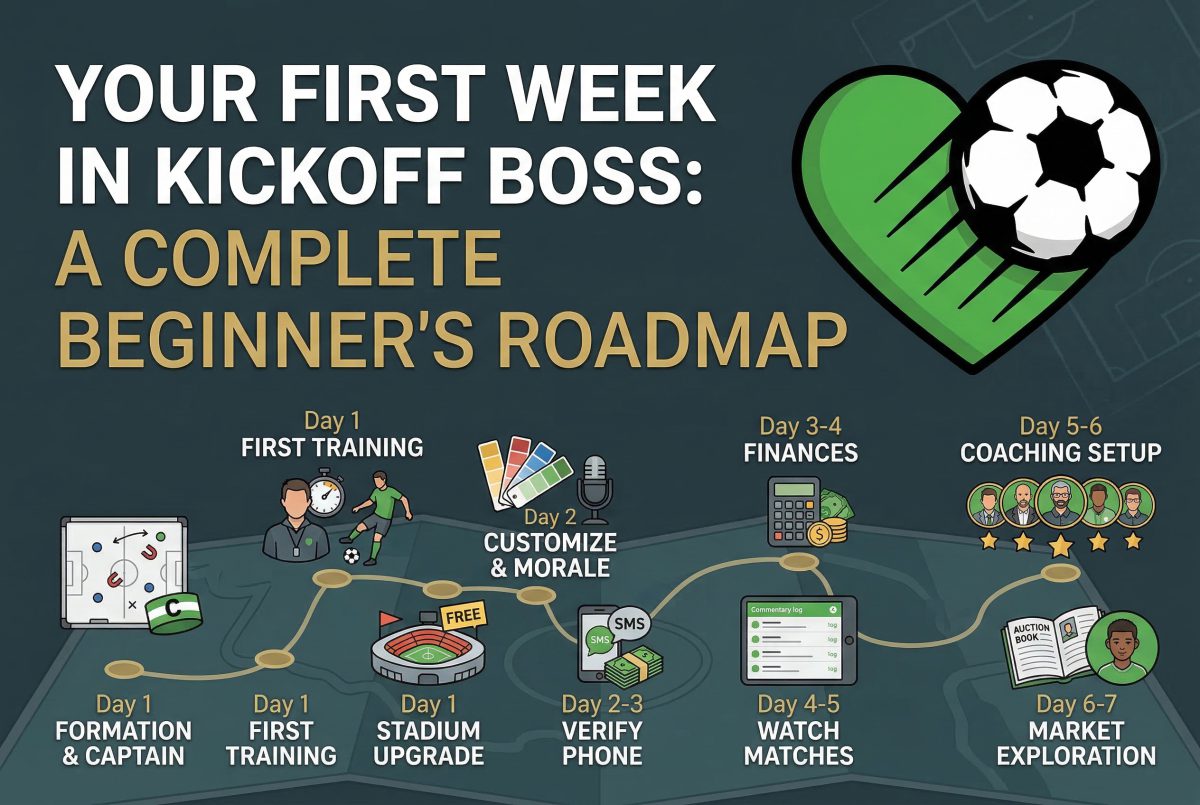
You've just registered, picked a country, and been handed a club in the lower divisions. You have 20 players, two coaches, an empty stadium, and no idea what to prioritize. This is what your first week should look like.
What you're starting with
Every new manager gets the same foundation:
- 20 players — a mix of goalkeepers, defenders, midfielders and forwards. Quality will be modest, mostly in the 40–55 range. That's normal for the lower divisions.
- 2 coaches — randomly assigned, both 1-star. They'll do for now.
- Morale at 90 — just below neutral (100 is neutral). Win your early matches and you'll get there fast.
- Popularity at 50% — this determines how many fans show up. It'll grow as you win.
- Stadium at level 0 — 500 seats. Your first upgrade is free.
- All facilities at level 1 — training ground, youth center, medical center, dressing room.
You start in division 3 or 4. The competition is manageable, which gives you time to learn the systems before facing tougher opponents.
Day 1: Set up your formation
Go to the Tactics page first. This is the most important thing you'll do before your first match.
You start with a default 4-4-2. You can change it, but there's a reason to stick with one formation: experience. Every official match played with the same formation earns 1 star of formation experience, up to 5 stars. Each star gives your entire squad a 1% skill bonus in the next match. Switch formations and for every match your players may start forgetting. So pick one early and commit.
Pick your best players into the starting eleven. Put them in their natural positions, a player outside his position loses 20% of his skills during the match.
For tactical settings, start with Balanced mentality and Normal tempo. You can experiment later once you've watched a few matches and understand what the options do. The defaults won't hurt you.
While you're here, assign a captain, a free-kick taker, and a corner taker. These matter for set-piece situations in matches.
Day 1: Run your first training session
Head to the Training page and hit start. Training runs once per day and every session pushes your players toward their next skill level-up.
Your two starting coaches are already assigned to training types. Players set to those types get a coach bonus. Everyone else trains on General — it works, just slower. Don't worry about optimizing this yet. Just make sure you're running training every day. Missed sessions are progress you can't get back.
One useful detail: players who played a match in the last 24 hours get a 50% training bonus. So after match days, training is even more valuable.
Day 1: Upgrade your stadium
Go to the Stadium page. Your first upgrade is free, take it immediately. Each level adds 5,000 seats, and more seats means more ticket revenue from home matches. Upgrades take 3 days to complete, so starting early matters.
After the free upgrade, future levels cost Platinum. Don't rush them. Focus on earning from matches first, then reinvest when you can afford it.
Day 2: Customize your club
Visit the Office page. Change your club name, pick your colors, and choose a shirt pattern. This is cosmetic but it's your club, make it yours.
While you're in the Office, notice the Press Conference option. A press conference gives your team +5 morale instantly. You can issue one every 7 days. Your first one is free. Since you start at 90 morale and need to reach 100, a press conference plus a couple of wins gets you there. Use it.
Day 2–3: Verify your phone number
This is easy to overlook but critically important. Go to account verification and confirm your phone number via SMS. This does two things:
- Gives you 100 local currency as a reward — your first real chunk of currency.
- Unlocks the transfer market — without verification, you can't buy or sell players.
Until you verify, you're stuck with the 20 players you were given. Do it early.
Day 3–4: Understand your finances
Money in Kickoff Boss works on two main currencies:
- Platinum (Euro) — the premium currency. Used for stadium upgrades and facility upgrades and buying players.
- Gold — You can exchange Platinum into Gold at the currency exchange, this is used for hiring staff, league prizes, player related auctions, youth spawns, etc.
- Local Currency — Used for paying weekly expenses and stadium ticket prizes.
Every Monday at 00:10 server time, your club pays wages, player wages, coach wages, and infrastructure maintenance. If you can't cover them, you go into debt. Your players perform worse while you're in the red, and staying in debt for more than 3 weeks gets you sacked.
In the lower divisions with cheap players, wages are small. But keep an eye on your balance. If it's dropping toward zero, exchange some Gold or consider selling a squad player you don't need.
Day 4–5: Watch your first matches
League matches follow a set calendar. On most days there's one match, but on days 5, 10, 15, and 20 you'll play two league matches. You also enter the National Cup automatically, cup rounds start from day 2.
After each match, read the commentary. It's not just flavor text, it tells you what happened tactically. If your opponents keep scoring from crosses, your marking setup might need adjusting. If your striker never gets service, your build-up settings or formation might be isolating him.
Wins give you +2 morale and +1.5 popularity. Losses cost the same. Early wins matter, they build momentum that compounds through the season.
Day 5–6: Look at your coaches and training types
Now that you've seen a few training sessions run, it's worth understanding what your coaches actually do.
You have 5 specialist coaching types: Goalkeeping, Defending, Attacking, Technique, and Physical. Each one targets specific skills and gives a significant training speed bonus over General training. Even a 1-star specialized coach trains 47% faster than General.
Check which coaches you have and set your most important players to matching training types. A young striker should be on Attacking training. A promising midfielder might benefit from Technique. Players without a matching coach stay on General, that's fine for now, but hiring the right coaches is one of the best early investments you can make.
New coaches cost Gold. A 1-star coach is cheap. You don't need 5-star coaches yet, just having the right specializations matters more than the star rating at this stage.
Day 6–7: Explore the transfer market
With your phone verified, you now have access to the market. Don't rush to buy. Spend time browsing to understand player values and what's available.
A few things to know about the market:
- Auctions run for 24, 48, or 72 hours.
- Bids in the last 3 minutes extend the deadline by 3 minutes, so sniping isn't easy.
- When you sell a player, you keep 88%. The other 12% is split between the Partners Fund and the player's original club.
- You need at least 16 players in your squad to list anyone for sale.
For your first transfer, look for a young player (under 20) with high potential in a position where your squad is weak. Young players develop fast with training, and a good prospect picked up cheaply can become a key player within a few seasons.
By the end of week one
If you've followed this roughly, you should have:
- A locked-in formation building experience every match
- Training running daily with some players on specialized types
- A stadium upgrade underway or completed
- Phone verified, 100 local currency in hand, market access unlocked
- A press conference issued to push morale toward 100
- A basic understanding of your income and expenses
- A few matches played and some sense of how your team performs
None of this requires spending real money. The lower divisions are designed to let you learn the game and build gradually.
What to focus on next
After week one, your priorities shift to longer-term development:
- Youth center — scout and sign young players from your academy.
- Training ground upgrade — each level gives every player a permanent training speed boost.
- Hire scouts — they let you check the potential rating of players you don't own, and give you access to free agents from around the world.
- Promotion push — finish in the top 2 of your league to go up a division, where prizes and competition get better.
The season lasts 28 days. That's enough time to see real improvement if you're training daily and making smart decisions. By season two, you'll know exactly where your team needs strengthening and you'll have the tools and currency to do something about it.