Deutsch
 English
 Français
 Hrvatski
 Indonesia
 Italiano
 Nederlands
 Norsk
Norsk Polski
 Português
 Português, Brasil
 Română
 Svenska
 Türkçe
 Ελληνικά
 Български
 Српски
 العربية
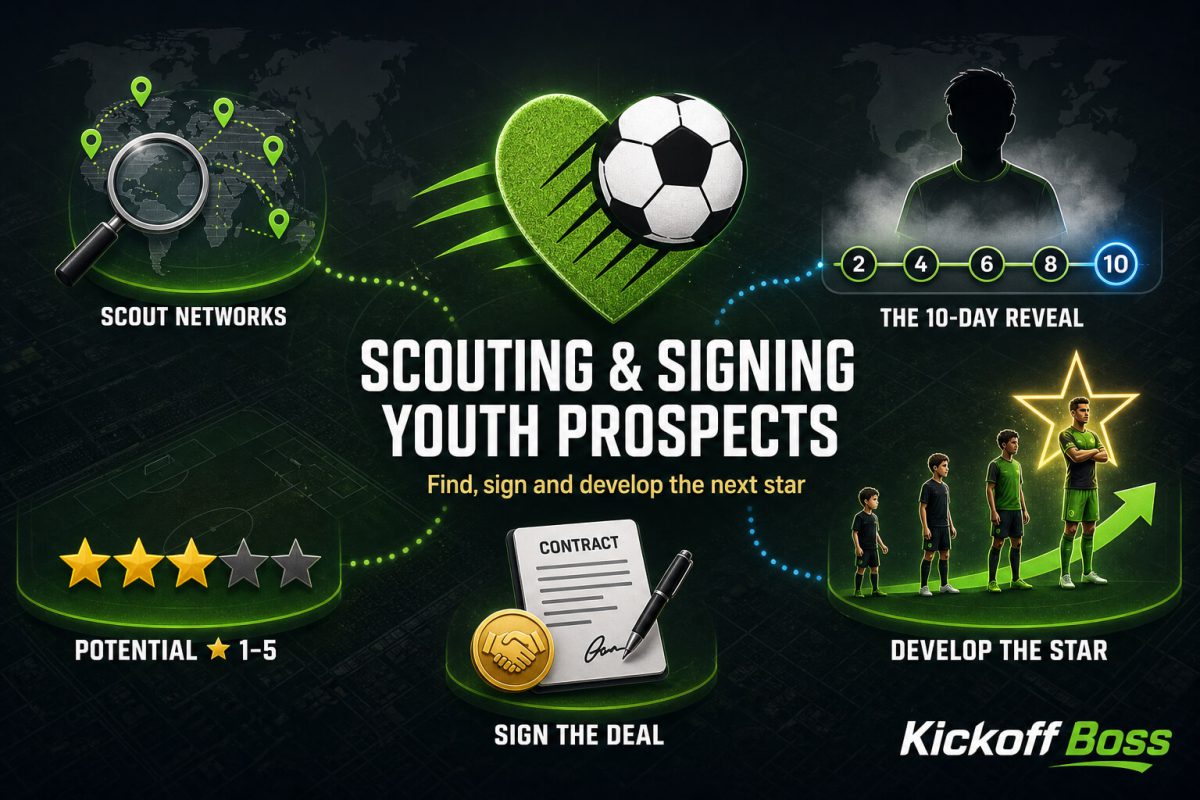
Youth prospects are the cheapest way to build a star from scratch in Kickoff Boss, but the game hides almost everything about a 15-year-old until you've watched him long enough. Here's what your scouts actually see, when they see it, and how to turn a gamble into a plan.
It's one of the most common questions in the forums: how do you know what position a young prospect plays, whether he's any good, and when it's worth spending the Gold? The short answer is that the game reveals a prospect's details on a fixed timetable, and almost everything you do well here comes down to reading that timetable.
Where prospects come from
Every playable country keeps its own rolling pool of prospects, 15-year-olds waiting to be signed, usually a handful per country at any moment.
Two things matter about that pool. First, the same prospects are visible to every manager who can see that country, so when you sign one he's gone for everyone else. Second, each prospect only sticks around for about 15 days before he abandons the pool and a fresh face replaces him. The pool is constantly turning over, and the good ones don't wait for you.
What your scouts reveal, and when
This is the part that trips people up. A prospect's information unlocks gradually based on how many days he's been available, not something you control. The longer he sits in the pool, the more your scouts piece together:
- Day 0–1: Name and age (always 15)
- Day 2–3: + Preferred foot and height
- Day 4–5: + Whether he has a special trait
- Day 6–7: + Average quality
- Day 8–9: + Full skill breakdown
- Day 10+: + Position on the pitch
Yes, position is the last thing you learn. If you've ever signed a prospect hoping for a winger and ended up with another centre-back, this is why. The position was fixed the moment he appeared; the game simply doesn't show it to you until day 10. And "day 10" has nothing to do with a player level, it's just the tenth day he's been available. Each prospect's card shows when he was scouted and how many of his six details are revealed so far, and his scouting timeline shows what unlocks next.
From day 10 his position also appears as a colour-coded tag next to his name — blue for goalkeepers, green for defenders, amber for midfielders, red for strikers, so you can spot the line you need at a glance.
Pro tip: The reveal timetable is the whole game-within-a-game. Sign on day 2 and you're buying a name and a hunch, but nobody else knows any more than you do. Wait until day 10 and you know his position and skills exactly, but so does everyone else, and you've only got a few days before a rival signs him or he abandons. There's no "right" answer, only how much risk you want to carry. The one exception worth bending the rule for is a prospect you can see has a special trait: those are the most fought-over, so if you spot one, signing before day 10 is often safer than gambling that he's still there later.
Seeing beyond your own backyard
By default you can only see prospects from your own country, for free, always. To look at any other country you need a scout assigned to that country's zone.
Scouts are hired on the Staff page for Gold, and one scout covers an entire zone:
- Europe — 26 countries
- Asia & Oceania — 12 countries
- Americas — 10 countries
- Africa — 5 countries
This is the real answer to "I only ever pull defenders." Your home pool is small and random, so if it isn't producing the position you need, a single scout opens up an entire zone of alternatives. And here's the trick the veterans use: prospects in busy footballing countries get signed fast, often in the dark, while prospects in quieter countries sit around long enough to pass day 10 and reveal their position before anyone grabs them. If you specifically need a left winger, you're far more likely to find a known one in a low-activity country than in a crowded one.
Signing: picking a potential tier
When you sign a prospect you choose a potential rating from 1 to 5 stars. This isn't a prediction of how good he'll become, it's a setting you're buying, and it does two things:
- It sets his training speed. A 5-star youth trains five times faster than a 1-star, for the rest of his career.
- It gives him a one-time head start in training progress. Since every 100% of progress lets you raise one skill, that head start is free skill points the day he walks in.
The tiers, cheapest to most expensive:
- 1 star — base speed, +300% progress (a 3-skill head start).
- 2 stars — 2× speed, +600% (6 skills).
- 3 stars — 3× speed, +900% (9 skills).
- 4 stars — 4× speed, +1,200% (12 skills).
- 5 stars — 5× speed, +1,500% (15 skills).
Two limits to know. You can only buy a tier up to your Youth Center level, so a level-3 youth academy caps you at 3-star signings. And your very first youth signing ever (via the tutorial) costs just 1 Gold (1-star), so there's no excuse not to try the system once.
The Gold fee doesn't vanish, either: 30% goes to the Partners Fund, 35% to the Global Fund, and 35% to your Local Federation. Sign a foreign prospect and that federation share is split between your federation and his home one. This Gold is later used for competition prizes.
The sVCT boost: skipping the wait
There's one more lever on the signing screen, and it only appears from your second signing onward. If you've got sVCT — the ingame stashed version of the VCT token you earn or buy from other managers with Platinum, you can spend it to pile up to 3,000% of extra training progress onto a prospect the moment you sign him.
Remember that every 100% of progress is one skill you get to raise. So a full sVCT boost is up to 30 skill points handed to you on day one, and it stacks straight on top of the head start from his star rating. Sign a 3-star (+900%) with a full boost (+3,000%) and that's 3,900% of progress waiting — 39 skills to distribute before he's kicked a ball for you.
You don't have to go all in. A slider lets you dial the boost in 100% steps — one skill at a time — and the cost scales with it: a full boost runs about €10 worth of sVCT, a third of the boost costs a third of that.
Pro tip: Think of it as a fast-forward button, not a magic wand. It brings forward training you'd otherwise grind out over seasons, but it doesn't change a player's potential, a 1-star is still a 1-star, just further along. Spend it where you can actually see what you're buying: on a prospect whose skills, trait and position have already been revealed (day 8–10). Pouring sVCT into a blind day-2 gamble is how a bargain becomes an expensive mistake.
Your Youth Center sets the ceiling
The Youth Center (upgraded on the Stadium page, in Platinum) is the backbone of the whole system. Its level controls three things at once: the highest star tier you can sign, how many young players you can hold, and how many you can sign per season. The star tier simply matches the level, and the other two are always the same number:
- Level 1 → 3 youths
- Level 2 → 5
- Level 3 → 7
- Level 4 → 9
- Level 5 → 11
So a level-1 academy means three 1-star signings a season; a level-5 academy means eleven slots and access to 5-star talent. Each level costs 10 Platinum and takes three days to build, and your club can only have one upgrade under way at a time, stadium and facilities included. A strong academy takes planning, which is exactly why it's a genuine competitive edge.
Turning a 15-year-old into a player
Signing him is the easy part. Development is where prospects are won and lost, and it runs on a simple idea — your youth's training progress each cycle is multiplied by every one of these:
- Potential — the star tier you bought (1× to 5×)
- Age — the youngest players train fastest. A 15-year-old gets a 3× multiplier; it drops to 2.5× at 16–19 and keeps falling. Train them young.
- Coach — a specialised coach beats general training, and a higher-rated coach beats a lower one
- Training Ground — higher facility level, faster progress
- Match minutes — a player who played a match in the last 24 hours trains 50% faster. Youth-league matches don't count, though, so this one only kicks in after promotion
- Tutoring — adds another 50%
That last one is worth setting up properly. Any senior player aged 30 or older can tutor a youth from the same area of the pitch, and the club allows one tutoring pair per area: goalkeeper, defence, midfield, attack. That's the reasoning behind the popular "one junior per line" approach — keep roughly one prospect in each area and you can have all four tutored at once, each getting a free 50% on top of everything else.
Every 100% of accumulated progress lets you raise one skill, and you choose which — so the head start from a higher star tier plus a fast pipeline means you're shaping the player you actually want, not just hoping he turns out well.
Spend that progress as it comes, though, because two rules punish a youth who's sitting on it:
- Training stops at 250%. A session can't lift a player's progress past 250%, and adds nothing at all while he's already above it. Every star tier's head start is bigger than that, so a new signing gains nothing from training until you've spent his progress below 250%.
- A new training regime starts from zero. Every prospect arrives on general training, and changing a player's regime, including moving him to a coach, resets his progress to 0%. Spend his head start on skills first, then make the switch.
Youths can be promoted to the first team at age 17, as long as you have dressing-room space. Don't leave it too late: any youth who is 18 or older and still in your academy when a season ends decides football isn't for him and leaves the game for good.
Pro tip: If your academy is still small, you don't have to develop a gem yourself. A good high-potential youth holds his value, and selling him to a bigger club early gets him a better training setup (he'll develop faster there) and gets you a healthy fee and because the transfer market pays a solidarity cut to a player's original club, you can keep earning from him seasons after he's gone. Spend any progress he's banked before you list him, though: a transfer resets it to 0%.
Putting it together
The honest summary: you can't pick a prospect's position, only discover it, and the better your information the more competition you face for it. Good youth management is just playing that trade-off well, scout wide so you're not stuck with your home pool, hunt quieter countries for known-position prospects, match your star tier to a training setup that can actually use it, and line up tutors before you need them. Do that for a few seasons and the academy stops being a lottery and becomes the cheapest title-winning squad you'll ever build.
For the bigger picture on every other way to bring in players, see How to Build Your Squad in Kickoff Boss.