Team morale is easy to ignore until suddenly your squad of quality players is getting beaten by sides half their caliber. It's not a vague "vibe" stat - it has a direct mathematical effect on every player in every match. Here's how it works.
The scale
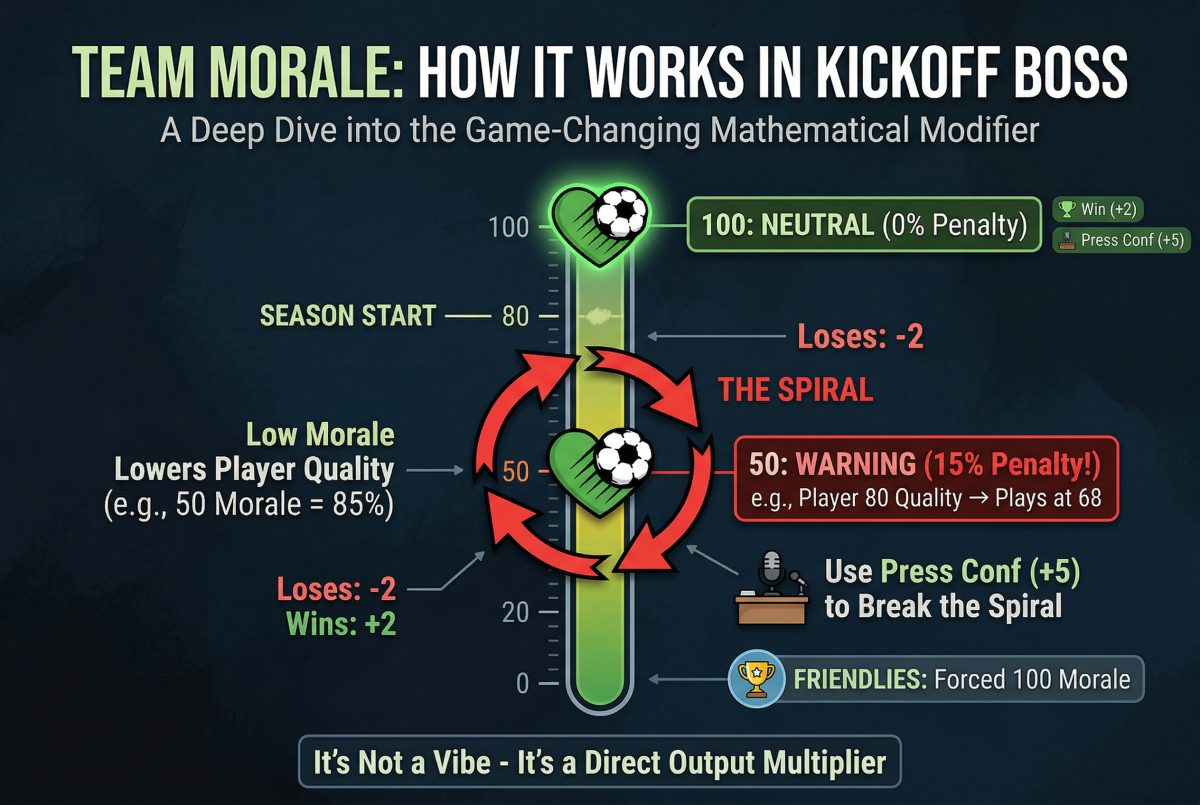
Morale runs from 1 to 100. You can see your current number in the left sidebar at any time. The important thing to understand about 100: it's not a bonus. It's neutral. Everything below 100 is actively hurting you.
What low morale actually costs you
Every time a player is involved in a match action, the engine applies a morale modifier to their skill rating. At morale 100, no effect. At morale 50, your players operate at 85% of their actual quality. At morale 1, that drops to 70%.
To put that in concrete terms: a team with average quality of 80 and morale stuck at 50 plays like a team with quality 68. Same players, worse results - because the game literally reduces their output before the match starts. Drop to morale 30 and you're looking at something closer to quality 62.
One side note worth knowing: friendly matches and in-game tournaments run at a forced morale of 100 for both sides. So preseason friendlies don't lift your morale, but they don't hurt it either.
How morale moves
Win: +2. Lose: -2. Draw: nothing changes.
That's the whole system. Match results drive morale and nothing else does it automatically. No weekly decay, no time-based recovery.
Where you start each season
At the beginning of every new season, all teams reset to 80. Not 100 - 80. You start the season already 20 points below neutral. Win your first few matches and you reach 100 quickly. Lose them and you're already sliding before the season has really begun.
If you take over a team as a new manager, you start at 90.
The spiral
This is where morale becomes genuinely dangerous.
Start a season at 80. Your first three matches are tough draws and you lose all of them. Morale is now 74. Your players are running at about 92% of their rated quality - not catastrophic, but enough to make the next matches slightly harder. You lose again. Morale hits 70, then 66. Another bad week and you're at 60.
At 60 morale, you're conceding 12% of your squad's quality. A quality-75 midfielder is playing like a quality-66. You're dropping points against teams you'd normally beat. Those losses push morale to 56, then 50. At 50 you're down 15% across the whole squad, which means you're now probably losing matches against teams you're better than on paper.
Teams that slip below 50 morale rarely recover without deliberate action. The problem is circular: low morale causes losses, and losses cause lower morale. By the time you're at 35, you need a run of wins to get out - but those wins are hard to get because your morale is what's preventing them.
How to stop the slide
The main recovery tool outside of match results is the press conference in your club office. A team press conference adds +5 morale immediately. You can issue one every 7 days - it won't solve a deep crisis on its own, but used consistently it can slow or stop a slide before it becomes unmanageable. Your first press conference is free; after that there's a gold cost.
If you're in genuine freefall, use it as soon as it's available. Five points of morale is roughly 2-3 wins' worth of recovery.
What this means in practice
Your first few matches of a season matter more than the points suggest. A good early run gets your morale to 100 and keeps it there for the rest of the season. A bad start can put you in a hole that shapes everything else.
If you're managing a weaker team, think about fixture difficulty early in the season. If you have any control over scheduling, pick your battles. Getting those first wins - even against easier opposition - is worth it beyond the table position.
And if you're already in a spiral, don't wait. Use the press conference, win whatever you can, and don't let it fall below 40.