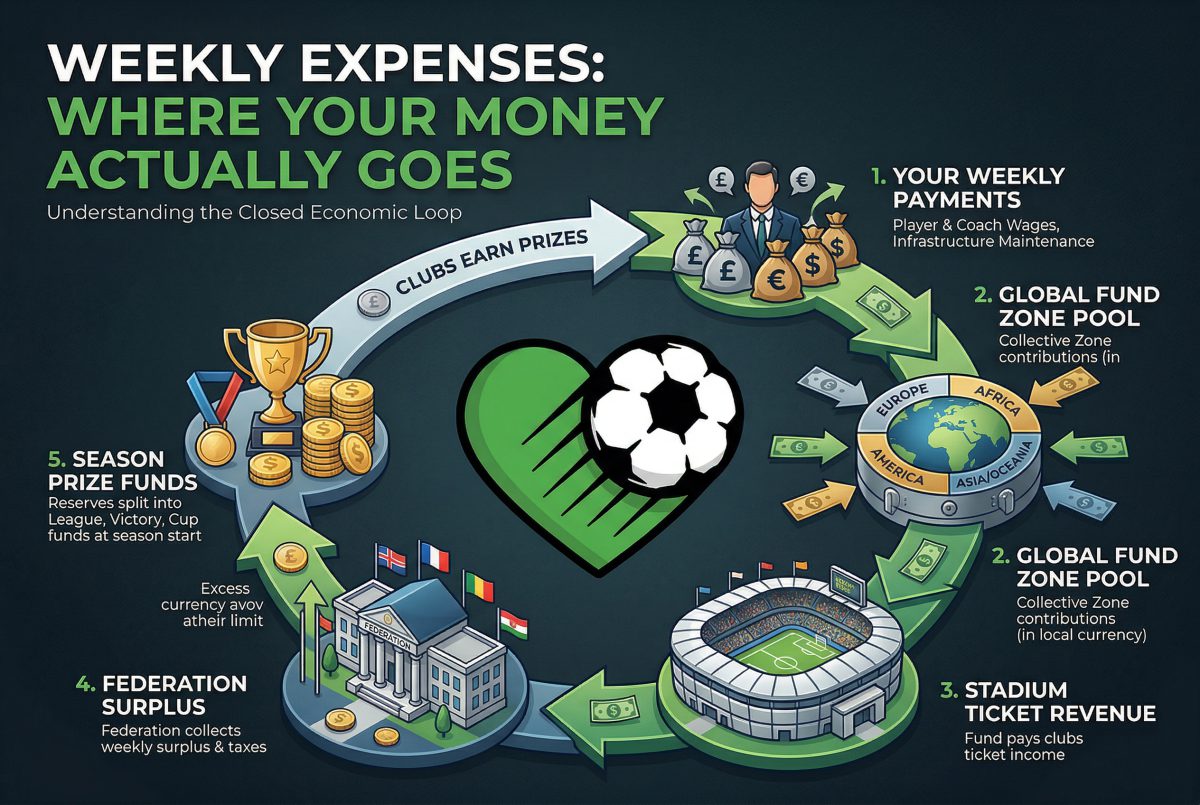
Every Monday at 00:10 server time, your club pays its bills. Player wages, coach wages, scout wages, infrastructure maintenance, all deducted automatically from your local currency balance. Most managers see the number go down and move on. But that money doesn't disappear. It enters a system that eventually comes back around as stadium revenue, federation funding, and next season's prizes.
Here's the full loop.
What you pay each week
Four things get deducted from your local currency balance every Monday:
Player wages are based on each player's average quality (AVQ) and age bracket. For most clubs, this is the line item that matters.
Coach wages depend on star rating. A 1-star coach costs 1 local currency per week, a 5-star costs 20. Scout wages are 1 local currency per scout per week.
Infrastructure maintenance covers running costs for your training ground, youth center, medical center, and dressing room, based on their current levels.
All of these are calculated in Platinum first, then converted Gold and to your local currency using the current exchange rates. Two clubs with the same squad quality pay the same amount in Platinum terms, whether they play in England or Nigeria. The local currency amount differs depending on the exchange rate, but the economic weight is identical.
The wages bonus
There's a fifth factor. You can set a wages bonus between 0% and 25% from your club office during the last few days of each season. It only applies to player wages, not coaches or scouts. For example setting a bonus of 15% means your players cost 15% more in wages each week. In return, they get a match performance boost, roughly +3% to their effective quality for every 5% of wage bonus.
The catch: the bonus locks in at the start of the season and costs you every single week, win or lose. A 25% bonus on a high-wage squad adds up. You'll feel it if your finances are tight.
Where the money goes: the Global Fund
When your club pays its weekly expenses, the money doesn't go into a void. It goes to the Global Fund for your continental zone.
Four zones (Europe, Asia & Oceania, South America & North America, Africa), each with its own fund, operating independently. Every club in a zone contributes to the same pool every Monday.
The fund holds currencies from every country in its zone. Your English club pays wages in Pounds, those Pounds land in the European fund's Pound balance. A Brazilian club pays in Reais, the American fund's Real balance grows. It's all the local currencies from every club, sitting in one place.
You can check the current state of any zone's fund on the Global Fund page. Platinum and Gold reserves, plus a breakdown of every local currency being held.
What the Global Fund pays for: stadium tickets
The fund isn't just sitting there with all the different local currencies. During the week, it has one major outgoing: stadium ticket revenue.
Every time a match is played and fans show up, the ticket revenue comes out of the Global Fund. Your club doesn't collect gate receipts from nowhere, KOB doesn't print fake money. 85% of the ticket income goes to the home team (50/50 for neutral venues), 15% goes to the local federation as tax.
So the wages your club pays on Monday become the fund's balance. That balance pays out stadium tickets during the week as matches happen. Matches with big stadiums and good attendance drain the fund faster.
The weekly report tracks all of it: how much came in from wages, coaches, scouts, infrastructure, and how much went out as ticket payments.
End of week: surplus goes to the federations
Every Monday, before the new round of wage payments, the Global Fund checks its balances. For each local currency, anything above 5,000 currency is surplus.
That surplus gets sent to the national federation the currency belongs to. The European fund is holding 8,200 British Pounds? 3,200 goes to the English federation. Holding 4,800 Swedish Krona? Nothing moves. Under the threshold.
Every currency, every zone, every week. That's how money moves from the global level down to the national level.
Federation reserves become next season's prizes
Those weekly transfers pile up in each federation's reserves throughout the season. The federation also collects from the 15% stadium tax, currency exchange fees, transfer market commissions, and other activity.
At the start of each new season, the federation takes its total reserves and splits them:
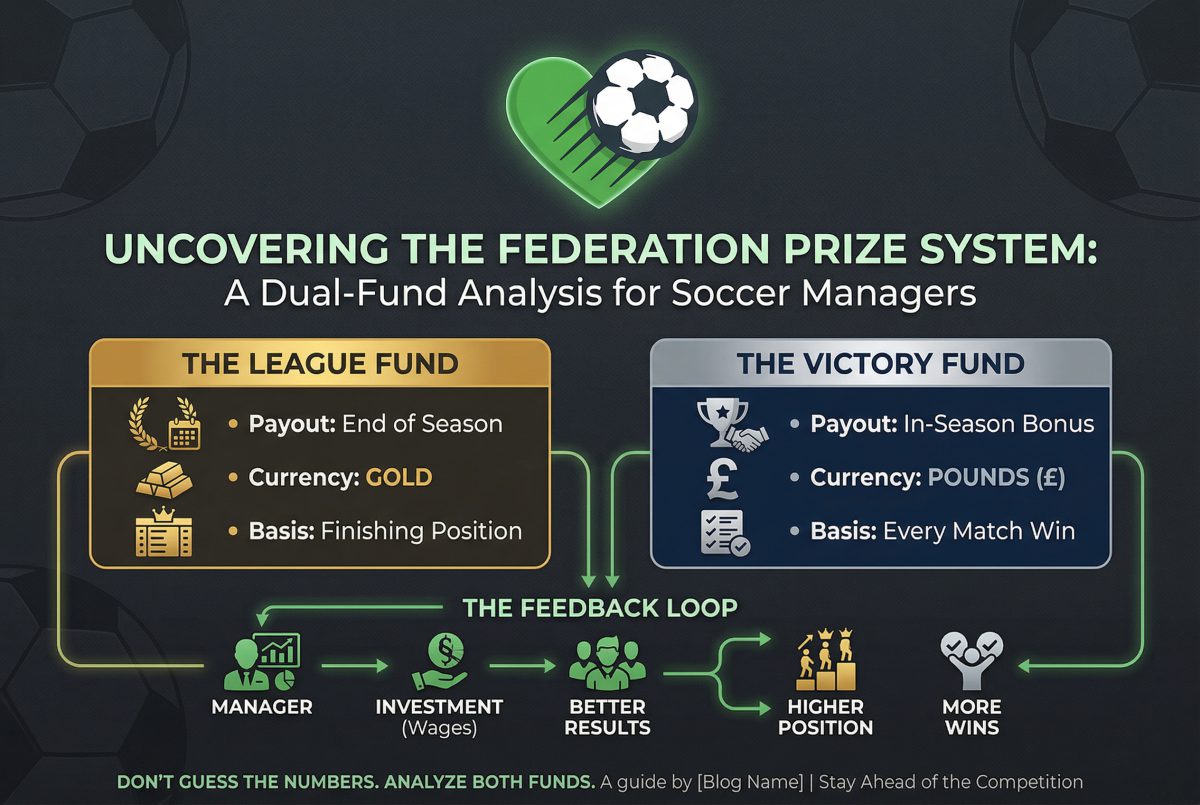
The League Fund pays Gold at the end of the season based on final league position. Higher divisions get bigger shares, weighted by wage expenditure. The Victory Fund pays local currency for every match win during the season, converted from Gold through the exchange market (which actually moves the exchange rate in the process). The Cup Fund pays Gold for advancing through each cup round. The Super Cup Fund goes to the Super Cup winner.
Each country sets its own allocation percentages. Federations with active managers, busy transfer markets, and well-attended stadiums end up with bigger pots.
The full circle
Your wage money on Monday enters the Global Fund. The fund pays stadium tickets during the week. Any surplus above 5,000 per currency goes to the national federation. The federation stockpiles all season. At season start, it creates the prize funds. Those prizes pay clubs.
Closed loop. The money your club spends this Monday ends up funding someone's league prize a few months from now.
Practical notes
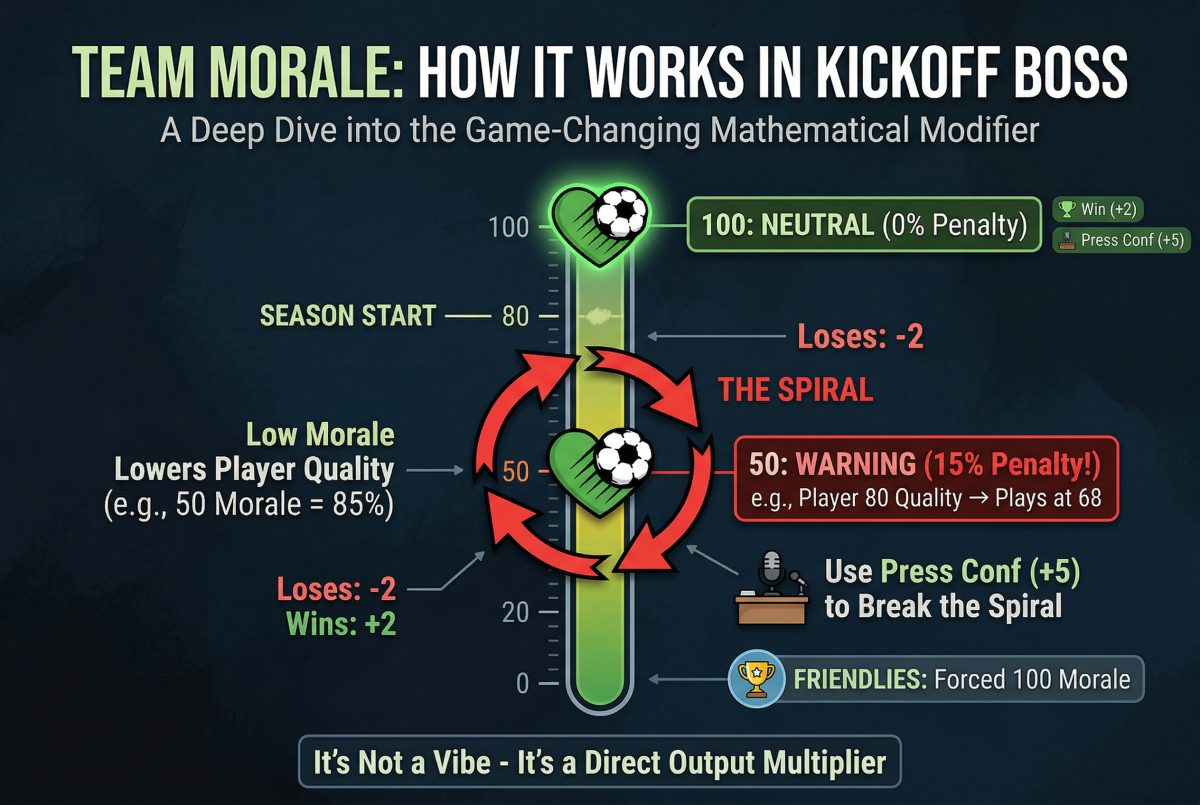
If your local currency balance goes negative, your players take a performance hit. Stay negative for three weeks and the board sacks you. Keep a buffer.
Your wages feed the economy. More spending across a country means a richer federation and bigger prizes for everyone in that league pyramid.
Stadium revenue is a real income line. It comes from the Global Fund, paid in local currency. Upgrading your stadium and managing ticket prices is worth thinking about, because that revenue is funded by the collective wage spending of every club in your zone.
Watch the exchange rate. It hits you when wages are converted from Platinum to local currency, and again when the federation converts Gold to local for the Victory Fund. A strong local currency means lower weekly bills but also less local currency per unit of Gold at season's end. There's a tension there worth paying attention to.